Showing posts with label Guide: Pattanaik. Calendar Art. Show all posts

Friday, August 19, 2016

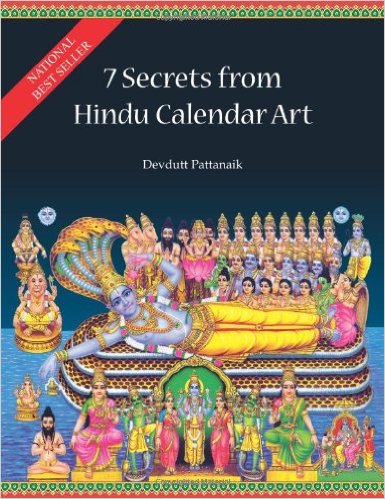
Overview: Pattanaik. Seven Secrets from Hindu Calendar Art.


As of July 2018, these videos were no longer at YouTube, but hopefully they will return.

Title: Seven Secrets from Hindu Calendar Art
Author: Devdutt Pattanaik
Year: 2009

Free Online: You can watch the videos for free at YouTube. I would strongly suggest getting the Kindle version also to help you with notetaking.

Kindle: You can buy your own Kindle copy from Amazon for $2.99 (checked price November 2017).

Length: three weeks. I've divided the videos into six parts: A - B (one week), then C - D (second week), and E - F (third week).

Part A - Ganesha
Part B - Narayan

Part C - Ardhanari, Shiva
Part D - Shiva, Devi

Part E - Vishnu
Part F - Brahma


Saturday, November 7, 2015

Guide. Pattanaik's Calendar Art: Part A (Ganesha)


As of July 2018, these videos were no longer at YouTube, but hopefully they will return.
This video comes from Devdutt Pattanaik's Seven Secrets from Hindu Calendar Art.

1. Ganesha's Secret (34 min.)


Ganesha's Secret: People See God Differently

Ganesha races with Kartikeya

[DP tells the story of Ganesha and Kartikeya's race around the world. Ganesha says to Kartikeya] "You went around the world. I went around my world. Tell me, which world matters more?"

"The world is objective; my world is subjective. The world is rational and scientific; my world is intuitive and emotional. The world is global; my world is local. Both are truths but, as Ganesha asks, what matters more?"

"Myth is an idea churned in my world; mythology is the set of stories, symbols, and rituals that communicate a myth."

"They speak a language that is indifferent to rationality. And so, rivers spout from Shiva's topknot and his son has an elephant head. A subject such as this must, therefore, be approached with empathy and a genuine spirit of curiosity."

"Empathy is sorely lacking in modern times. Everything is judged. Everything is measured."

Gods and Goddesses, gods and goddesses

"When Shiva shuts his eyes, the whole world ceases to be, which is why Shiva is called the destroyer, and is considered God." [there are lesser gods and goddesses, spelling in English with lower-case g]

"Parvati is a Goddess because she embodies the whole range of emotions from fear to love, from domination to affection, while Ganga, the river who spouts out from Shiva's topknot, is a goddess, her divinity restricted to the river she embodies."

"In a temple where Ganesha is worshipped exclusively or Karitkeya is alone, without his father or mother, the gods become God — finite manifestations of the infinite divine."

"She is called Saraswati, a Goddess sometimes addressed as Veda-mata, mother of the Vedas. Brahma did not compose the Vedas — no man can create anything without woman, not even God."

"The four heads represent four expressions of the Veda. They represent the four goals of life, each one validated by Vedic wisdom: dharma (righteous conduct), artha (economic activity), kama (pleasurable pursuits), and moksha (spiritual practices). Just as Brahma is incomplete without any of these four heads, life is incomplete without any of these four goals."

Khandoba: a local Shiva

"Sanskrit texts refer to Khandoba as Martand Bhairava, a fierce form of Shiva, local to the Deccan region. He is a kshetrapala, a guardian of land."

"As a protector, he fights demons. Some demons, like Mani, who ask for repentance, become deities in their own right within the temple precinct, while others, like Malla, whose image is embedded on the steps leading to the shrine, continue to be punished by being trampled on by devotees."

"Khandoba loves turmeric: his shrine, his devotees, and his images are covered in turmeric."

[Khandoba has wives from the merchant community, goatherd community, tailor, seed-pressers, etc.] "The tale of his many marriages binds various communities ritually through a single village-god. Thus each community retains its own identity while being united through Khandoba."

"By linking Khandoba, a local village deity, to a pan-Hindu God like Shiva, the village becomes part of a larger Hindu community. The village is unique, yet part of a greater whole. Its local god is a local manifestation of a more cosmic God."

Other local deities

[DP tells the story of how Vishnu visited earth, fell in love with a princess named Padmavati, and she demanded a bridal price. Vishnu borrowed money from Kubera, and has yet to repay it, so he remains on earth as Tirupati Balaji in Andhra Pradesh.]

[DP discusses the Gujarati goddesses Chamunda and Chotila, who may be local manifestations of Shakti / Parvati as Chamunda, who slew the demons Chanda and Munda.]

"These two goddesses are warriors, and their martial potency is retained by not allowing themselves to be diverted by matrimony or maternity."

[DP discusses theories that these were local people later deified.] "Such conclusions are attempts to rationalize a religious practice, and rarely have an impact on the faith."

DP discusses 12th-century Tamil poet saint Andal / Godal who was "know as the consort of the temple deity, and over time came to be regarded as a goddess."

[DP discusses devadasis.] "In the shrine of Khandoba existed vaghyas and muralis, boys and girls dedicated to the deity, who were not allowed to marry and who were expected to earn a living by singing and dancing."

India and Greece

[DP discusses Vishwakarma, the "Vedic Vulcan," and notes also similarities of Kama and Cupid, and Indra and Zeus.] "Greek mythology is quite different from Hindu mythology. The Greeks did not believe in God — they had gods and goddesses, but no God or Goddess."

"The gods of Greek mythology became masters of the universe by overthrowing the Titans, an earlier race of powerful beings, who in turn had become powerful by overcoming Giants. Such a theme of repeat succession is missing in Vedic literature."

"Not much is known about Vishwakarma. Some identify him with Brahma himself. He is said to have given shape to the world. It is he who fashions the child in a mother's womb."

Bahuchara, goddess of the Hijras

[DP discusses Bahuchara, the goddess of Hijras.] "Hijras are men who feel they are women and so not live in mainstream society. They dress as women and live with other Hijras."

[DP tells the story of two friends; a holy man said one would father a son, another a daughter. They pledged their children in marriage, but the supposed son was born a daughter, raised as a boy, and then sent to fetch his bride.] "She traveled on a mare to the village of the bride. On the way, both fell into a pond. When they emerged, she had become a man and the mare had become a horse. A bitch who was following them and had also fallen into the water turned into a dog. This all happened because Bahuchara was next to the pond."

"Other stories of this goddess tell us that she was a young girl who turned a thief into a Hijra when he dared t molest her while she was on her way to her wedding. Others say that she was a bride who was horrified to discover that her husband was not a man but a Hijra, and so turned into a goddess offering salvation to all Hijras if they served her rather than marrying women. Thus, through this goddess, even the most marginalized minority is included by the divine."

Annapurna and Gayatri

[DP discusses Annapurna, the kitchen goddess, whose most popular shrine is in Kashi (Varanasi).]

[DP discusses Gayatri, a Vedic hymn.] "Chanting the hymn and contemplating on it was only possible for those with superior concentration powers. For most people, a more emotive approach to the idea was required, and so the hymn came to be visualized as a goddess. Through the adoration of this goddess, one hoped to get the same outcome as by chanting the hymn. Thus the idea of the Gayatri hymn came to be embodied within the image of a goddess called Gayatri."

Back to Ganesha

[DP then analyzes the symbolism of Ganesha's elephant head, his fat belly, his rat vehicle.] "Ganesha represents a life full of power and prosperity without any problems. The form of Ganesha is a container of an idea. Ganesha is worshipped because the idea that he evokes is something that Hindus aspire for."

[DP tells the story of Ganesha's birth.] "While bathing, Parvati scrubbed the turmeric paste she had anointed her body with and molded it into a doll, into which she breathed life. The child thus created was named Vinayaka, one who is born without (vina) the help of man (nayaka)."

[DP goes on to tell how Shiva did not know the boy, beheaded him, and then replaced the head with the elephant head of Indra's elephant, Airavat.] "Ganesha thus represents the union of two opposites — Shiva who does not want to marry and raise a family, and his wife who does. Shiva represents spiritual aspiration, the desire to focus on the soul within. Parvati represents material aspiration, the desire to focus on the family and the world around. Hindus have always sensed a tension between these two goals. Ganesha represents a balance between the two." [So also his material body and spiritual head.]

"So this one image of Ganesha can serve as a medium to lofty metaphysical ideas to the Hindu and at the same time function at a very basic level — providing luck as one goes about facing the daily tribulations of life."

"There are gods, goddesses, Gods and Goddesses trying to convey that the divine is both abstract and concrete, both local and global, embodying not only spirit but also matter. Together, they attempt to capture the totality of the infinite divine. Together, they serve as windows to the Hindu worldview."


Parvati, Ganesha, and Shiva

Friday, November 6, 2015

Guide. Pattanaik's Calendar Art: Part B (Narayan)


As of July 2018, these videos were no longer at YouTube, but hopefully they will return.
This video comes from Devdutt Pattanaik's Seven Secrets from Hindu Calendar Art.

2. Narayan's Secret (28 min.)


Narayan's Secret: What Dies Is Always Reborn.

Narayan sleeping and waking

"Just as our world does not exist when we sleep, the whole universe does not exist when God is in deep slumber. Narayan is God."

"The Greeks did not believe in rebirth. Neither do Christians and Muslims. There is only one life and hence the sense of urgency. It's an urgency that does not exist for Hindus. This life is one of the many lives we are supposed to live. This world is one of the many worlds that have come and gone."

"The ocean of milk thus represents possibility. When Narayan is asleep, the world entropies; there is no form, no identity — just a homogenous mass of matter, waiting to be churned."

"The serpent on whom Narayan is sleeping is called Shesha, the remainder, that which remains when all else is destroyed. Some say that makes him a representation of time. No one is sure, for when one is in deep slumber, how does one know what is left behind?"

"According to Vedanta, without the observer, there is no observation. Narayan is the observer. When he is asleep, he observes nothing."

"When Narayan's eyes open, his senses become sensitive to the world around him. Consciousness, which was like an uncreased piece of paper, has now started to crumple. The world ceases to be pure: it has color and shape and value; some things we like, some things we don't. This crumpled consciousness, not as pure as Narayan, is visualized as Brahma, seated on a lotus that has sprouted out of Narayan's navel."

Lakshmi and Shiva

"At Narayan's feet is his consort, Lakshmi, the Goddess of wealth. She nourishes mankind. She is also portrayed as a cow. The cow is the world and whenever the world is in trouble, Narayan rushes to her rescue. Narayan awake is called Vishnu, the guardian, the protector, the preserver."

[DP also discusses the presence of Shiva in the image; Shiva will be the subject of another video.]

Tumburu and Narada

[DP discusses Narada and the horse-headed Tumburu, rival musicians who figure in several stories about Vishnu.]

"Narada was created from the mind of Brahma. On his birth, he had no interest in the world and encouraged all creatures not to marry or reproduce. This angered Brahma, who cursed Narada that he would move around the world restlessly and live till it was time for Vishnu to sleep no more."

"Narada enjoys provoking people. He constantly compares people and thus spreads anger and ignites quarrels. He fills the mind with jealousy and insecurity."

Garuda and Hanuman

[DP discusses Vishnu's vehicle, Garuda, the cosmic hawk.] "Vishnu's association with both serpent and hawk, the still Shesha and the flying Garuda, represents consciousness in both sleeping and waking states."

[DP notes the presence of Hanuman who aided Vishnu in his incarnation as Rama.]

Markandeya: creation and destruction

"Hindu scriptures repeatedly refer to creation as the result of awareness. Things are born when we become aware of them. Thus creation is not an objective construction — it is a subjective realization."

"Things are created every second and, with each creation, something is destroyed. Creation is like a wave. Hence destruction is visualized as a storm ocean where ideas collapse and dissolve as new things struggle to churn their way out."

[DP tells about the sage Markandeya who had a vision of Pralaya, the end of the world in a deluge of water.]

"The sight of the dying world filled Markandeya with dread and despair. It was then he heard a gurgling happy sound. He turned around and found a baby lying on a banyan leaf, cradled by the waves of destruction."

"This is fundamentally different from the Greek and Biblical worldview, where death is a full-stop. In the Hindu world-view, death is a comma; there is no full-stop."

[DP analyzes a picture of baby Narayan.] The baby holds a flute in his right hand and his right big toe with his left hand. The right side in Indian art represents the soul and intellect because the left side, with the beating heart, represents movement, hence matter and emotions. By holding the right toe with the left hand, God is connecting the spiritual with the material, the intellectual with the emotional, all the while making music with the flute, indicating a playful approach to life."

[DP discusses problem of depicting the soul, which is beyond form, in the forms of art.]

Narasimha: Hiranyakashipu and Prahlada

[DP next tells the story of Hiranyakashipu, who thought he was immortal, unable to be killed] "by any humor or any animal, any god or any demon, by a weapon or a tool, inside any dwelling or outside, above the ground or under it, during the day or night."

[H's son Prahlada insists that Vishnu is everywhere, even in the palace's pillars. H smashes a pillar.] "From this pillar emerges a fantastic creature called Narasimha, part lion and part human. This creature crosses the boundary between the animal and the human world. It emerges from the realm of impossibility, breaking all boundaries, challenging our notions of what is normal and what is not. Narasimha is God, he is a form of Narayan."

"This creature, neither man nor animal, or perhaps one who is both, drags Hiranyakashipu to the threshold of the palace — neither inside a dwelling nor outside. There, at twilight, which is neither day nor night, he places Hiranyakashipu on his lap, which is neither under the ground nor on the ground nor above the ground, and tears him apart with his fangs, which are neither weapons nor tools."

[Narasimha is so violent that Lakshmi appears and tells him to calm down.]

Vishwarupa: Krishna and Arjuna

[DP now discusses Krishna appearing to Arjuna before the battle of Kurukshetra, when Krishna reveals God's Song, the Bhagavad-Gita.]

"Actions born of desire, we are told, entrap us in a never-ending wheel of birth and death. Escape is possible if one is willing to discipline the mind, rein in desire, and act dispassionately, doing one's duty, stripped of any desire to dominate the world or indulge the ego."

[Krishna then shows Arjuna his cosmic form, Vishwarupa.] "He is what was, is, and will be. He is all forms. he is all directions. He is all that is possible and all that is impossible. Arjuna seeks Krishna exhaling life and inhaling death. Whole worlds emerge from his mouth and are ground by his teeth."

"This is the Hindu idea of God. God is all things. He is in all things. He is outside all things. He is She. He and She are also it. That which is animate and that which inanimate — everything is God."

"We are the observers who create the observation tha tis life. We are thus not separate from our lives. We and our world are the same. This is Advaita, or non-duality of being."

"We are God too — we just have not discovered the truth of ourselves. We are limited by our egos, our imperfect understanding of the world, our prejudices and our memories."

Cycles

"Since the Hindu world is going through cycles of life and death, this life is but one of the many lives to lead. There is therefore no dominant urge to be a hero. There is no sense of urgency. And since all things depend on points of view, there is a lack of certainty in all things."

"One yearns for that which is absolute, permanent, and independent of all contexts. That is the soul — the soul whose sleep leads to destruction and whose awakening leads to createion, whose observation gives shape to the world. The discovery of the one who creates the world, that observer, is the purpose of life."


Shesha, Vishnu, Brahma, Lakshmi

Thursday, November 5, 2015

Guide. Pattanaik's Calendar Art: Part C (Ardhanari, Shiva)


As of July 2018, these videos were no longer at YouTube, but hopefully they will return.
These two videos come from Devdutt Pattanaik's Seven Secrets from Hindu Calendar Art.

3. Ardhanari's Secret (21 min.)


Shiva's Secret: Withdrawal Leads to Destruction

4-1. Shiva's Secret Part 1 (13 min.)


Ardhanari's Secret: God is Stillness Within, Goddess is Movement Around

God: male and female

"For Hindus, God is never limited to one form. The idea of God is expressed through plants, animals, minerals, humans (male and female), and even forms that combine various beings."

"For most Hindus, God is best embodied in the form of three human couples: Brahma and Saraswati, Vishu and Lakshmi, Shiva and Shakti."

"Brahma is the creator, Vishnu is the sutainer, and Shiva is the destroyer. Brahma, with four heads and a book, looks like a priest; Vishnu, with four arms holding a conch-shell, disc, mace, and lotus, looks like a king; Shiva, with his trident, looks like a mendicant."

"Lakshmi, Saraswati, and Shakti embody wealth, knowledge, and power."

"The male trinity is associated with verbs: creating, sustaining, destroying. The female trinity, on the other hand, is associated with nouns: knowledge, wealth, power. Wealth, knowledge, and power can be created, sustained, or destroyed."

"The male triad signifies the individual, the observer, the one who acts, the one who senses, the one who responds. The female triad then signifies the observation which stimulates and provokes reaction and is a recipient of reaction — the world created by mind and matter, our world of thoughts, emotions, and sensations."

"The Gods are within all of us. The Goddesses are around all of us."

"The human male physiology creates life outside itself. On the other hand, life is created within the human female's body. Thus, the female form best represents the container, the source of all things material. The woman becomes the symbol of material reality, making man the symbol of spiritual reality." [DP adds that these are representations, not reality; what they symbolize, not what they are.]

Maya: judging and measuring

"A bowl of rice will satisfy the hunger of a king as well as that of a beggar. The Goddess does not discriminate; she represents an absence of judgment."

"The capacity to judge is embodied in male forms. God creates, sustains, and destroys society. He is the fountainhead of values, morality, and ethics."

"The Sanskrit word for measurement is maya — that is why the Goddess is called Mahamaya, the great one who can be measured and evaluated. She is matter, she is energy, her various forms are created, sustained, or destroyed by the one who observes her."

"When Narayan wakes up, the Goddess is observed through the senses. She is classified using words, limited by thoughts, and measured with scales."

"That is why this material world of changing forms is often referred to as maya, the embodiment of delusion. She is the world that we experience. As she keeps changing, we struggle to control her, hold her still and make her permanent, but we fail, for her essential nature is to transform."

"That we experience the restlessness of Maya makes us realize there is Atma, the soul, watching the dance of the enchantress."

Truths: changing and unchanging

"The Upanishads, ancient Hindu scriptures dating to 500 BCE, constantly refer to these two truths: a truth which changes and a truth which does not change."

[DP discusses the banyan tree versus grass and grain as examples of these complementary truths. The cobra, meanwhile, is both the still spiritual soul and the moving material world. A mineral pair would be ash as unchanging permanence versus snow as stilled water.]

"The river is moving water, and best represents the changing truth, the impermanent world. Shiva stills the flowing river-nymph Ganga in the locks of his hair because she has the power to overwhelm the world and the mind with her flow."

[DP also discusses color symbolism in terms of stillness and movement.]

"In space, the Pole Star is still, hence the northern direction came to be associated with stillness and wisdom and immortality, while the southern direction came to be associated with change and death."

[So too with right as still, left as moving from the beating of the heart.]

"Amongst humans, the celibate hermit represents the still soul, while the dancing nymph represents the moving world."

Ardhanari

"Unfortunately, we live in a world were people focus on form rather than idea; we assume representation is reality and Ardhanareshwara is decoded as a half-woman god rather than the divine, which is half-matter and half-spirit."

"The male half represents the formless divine known in Vedas as Purusha, in Viashnava manuscripts as Narayan, and in Shaiva manuscripts as Shiva. The female half represents the divine that has form (male, female, and neuter forms). The female form in known in Vedas as Prakriti, in Vaishnava manuscripts as Maya, and in Shaiva manuscripts as Shakti."

Stories about Parvati

[DP tells a Tamil story about Shiva, Parvati, and Bhringi.] "Shiva's devotee, Bhringi, wanted to circumambulate Shiva but not Shiva's consort, Parvati. Parvati would not allow that. She sat on Shiva's lap, making it impossible for the ascentic to pass between them. When Bhringi took the form of a bee to fly between their heads, she merged herself with Shiva, so that she became his left half." [Bhringi then became a worm and tried to bore between them, and Parvati cursed him.]

[DP tells another story in which Parvati is jealous Ganga on Shiva's head so Shiva merges his body with Parvati's.]

Reality: spiritual and material

"Spiritual reality is incomplete without material reality."

"Through material reality alone can we experience spiritual reality."

[DP observes the left-right distinction that plays out in these images, with the right privileged.]

"Our life is a continuous dialogue between the divine within and the divine without, between God and Goddess, for without either there is neither."


Ardhanari
(Wikimedia)

Shiva the destroyer

"What does Shiva destroy? Sacred scriptures tell us repeatedly that he is Kamataka, Yamantaka, and Tripurantaka — destroyer of Kama, destroyer of Yama, and destroyer of Tripura, which means destroyer of desire, destroyer of death, and destroyer of the three worlds."

"With his third eye, he releases a flame that reduces Kama into a heap of hash. Kama is the god who makes us want things. Shiva destroys the one who provokes desire. Shiva wants nothing."

"By destroying Yama, Shiva destroys karma, that which rotates the wheel of life. With the end of Yama, there is no death, there is no rebirth, and the wheel of life grinds to a halt."

"Shiva destroys our desire for life; he destroys our fear of death; he destroys our need for the world around us."

Symbols of Shiva

"Ash is the symbol of destruction as well as permanence, for it is created by burning things but cannot be burnt itself. Thus, it is also the symbol of the immortal soul, released when matter is destroyed."

"Shiva is smeared with three lines of ash oriented horizontally. These refer to the three destroyed worlds."

"Shiva's trident, where three blades unit to form one staff, indicates the dissolution of the three worlds into one."

"Shiva destroys the division between the subject and the object, between the observer and the observation. The three worlds become one, and the one is the self."

"How does he destroy? By shutting his eyes, by refusing to be an observer, hence not creating an observation."

"Shiva's destruction of desire and karma make him worthy of worship."

"Shiva's arousal is swayambhu, self-stirred, not the result of external stimulation, but the result of internal bliss. Thus, the erect phallus is not a visual representation of rasa or material joy, but of ananda or spiritual bliss, one born of self-containment."

Shiva and Kali

"God needs Goddess. The destroyer thus must be made to open his eyes. That is why the Goddess transforms into her most primal form, Kali, and dances on Shiva."

"Kali wants Shiva to value material reality and care for it. She wants him to open his eyes and become the observer."

"Kali is movement, shiva is stillness; Kali is vertical, Shiva is horizontal. Kali resides in the south, where death also resides as Yama, while Shiva resides in the north, as still as the Pole Star and the snow-clad mountains."

"The Goddess resurrects life and death. She rotates the wheel of rebirths so that once again everyone experiences the yearning for living and the fear of death. These two emotions make man chase wealth and wisdom, manifested as Lakshmi and Saraswati."

"This form of the Goddess is called Tripurasundari, the one who embodies the beauty of the three worlds, the very same worlds that Shiva destroyed, whose ash smears his forehead."

"Shiva needs to be engaged with the world and marry the Goddess. He is becoming Shankara, more aligned with the ways of the world."


Wednesday, November 4, 2015

Guide. Pattanaik's Calendar Art: Part D (Shiva, Devi)


As of July 2018, these videos were no longer at YouTube, but hopefully they will return.
These two videos come from Devdutt Pattanaik's Seven Secrets from Hindu Calendar Art. The Vishnu video is continued in the next part.

4-2. Shiva's Secret Part 2 (15 min.)


5. Devi's Secret (17 min.)


Shiva the householder

[About Shiva's marriage to Sati and her death:] In rage, Shiva beheaded his father-in-law after destroying his sacrificial altar. Here he played the role of a conventional destroyer — destroying a social order that made no sense to him."

[He then tells of Shiva's rejection of Kama, and how Parvati persisted until he became her husband.] "With this, he became the householder. He became Shankara."

"Parvati begged Shiva to accept worldly ways and be a more presentable groom. He indulged her and became a beautiful god, Somasundara, as beautiful as the moon, and married the Goddess."

"Judgment is impossible without standards. For the hermit, these standards may seem cultural delusions, but for the householder, these are essential cornerstones of civilization."

More stories of Shiva

[DP tells the story of Shiva drinking the poison at the time of the churning of the Ocean. He also tells the story of Shiva preventing Yama from killing young Markandeya.]

[About Shiva catching Ganga as she fell:] "Shiva symbolically takes the role of the yogi, one who is able to control the mind so that it is not a slave of matter."

"The moon was once cursed with a wasting disease and so it took shelter on Shiva's head. Contact with Shiva helped the waning moon wax again, for Shiva is the source of all potency. That is why the crescent moon is always shown on Shiva's forehead."

[Shiva dancing:] This posture is the famous Tandava, which essentially means the more aggressive masculine form of dance, distinguishing it from Lasya, the more enchanting feminine form of dance."

Kartikeya: son of Shiva

[DP tells the story of Kartikeya's birth from Shiva's super-potent sperm. He also discusses Kartikeya's wives; in north India, he is unmarried, but in south India he has two wives:] "They are Devasena, daughter of Indra, the god of the sky, and Valli, daughter of a local tribal chieftain." 

[DP discusses Kartikeya' refusal to associate with women in the north, while:] In the south, he is worshipped wither as Kumara, the bachelor, or Subramanium, the married god."

Shiva-Linga

[An image of two crisscrossing triangle:] This is a geometrical representation of the union of material and spiritual reality. The upward pointing triangle, like a mountain, represents stability, stillness, and God. The downward pointing triangle, like a waterfall, represents instability, movement, and Goddess. When they are separate they look like Shiva's rattle-drum. But when united, they form a six-pointed star. These are yantras or geometrical communications of metaphysical ideas."

[Shiva-linga:] The upwardly protruding pillar is conceptually the same as the upward-pointing triangle. The trough below on which the pillar stands is conceptually the same as the downward-pointing triangle. Thus, it is the union of the changing truth of matter (downward pointing triangle / yoni) and the unchanging truth of the spirit (upward pointing triangle / linga)."

"Pots without stable bases hang on top of the Shiva-linga. The base is punctured so that water drips continuously, to remind us that worldly life is about movement and life ebbs with each passing moment as water flows out of a broken pot. We have to use this finite time we have with us to disccover the truth of spirit and matter, how when they engage there is creation and how when they disengage there is destruction."


Devi's Secret: Desire and Destiny Create Life

"This is Kanyakumari, the virgin goddess, and her temple is located in the southern tip of India."

[She was to marry Shiva, and he was traveling to her from the north in one night, reaching her before dawn. But the gods made a rooster crow, and Shiva turned back.] "The goddess, bedecked in bridal finery, waited and waited for the groom who would never come. All the food that had been cooked for the wedding feast went to waste. In rate she kicked the pots and pans and wiped her face of make-up. That is why the sea and sands on the southern tip of India are so multicolored."

"The goddess is a symbol of the material world. We want this world to be like a mother so that it can feed us; we want this world to be like a warrior so that it can defend us. So, the Goddess and her many diminutive doubles, the goddesses of households and villages, are mothers and warriors, loving and fearful."

"Man begs the goddess to allow herself to become domesticated and become a mother. But he knows she is wild and dangerous and can strike him down any time."

"Under her feet grovels a demon. Who is this demon? This demon is man who seeks to destroy nature to establish his settlement. He is that part of man that seeks to dominate the forest and make the goddess his mistress."

[DP analyzes an image of Lakshmi to show all the goodness and bounty shown there. He then analyzes Bhagavati, a goddess of Kerala who is both the wild goddess and the goddess Parvati.] Bhagavati is a local form of Shakti, the goddess of power.

[DP analyzes the Goddess shown as Kamakshi with Kama's sugarcane bow and flower arrow.]

"A man's desire is fulfilled by engaging with the world. From the world come wealth, knowledge, and power. Man can take all this from the Goddess, but the Goddess also asks him to give some things in return. She may be the object, the observation, but she demands that the subject, the observer, engage with her not with the language fo domination, but with the language of love."

"The axe is the symbol of death and division. The axe kills and separates the flesh from the soul."

"The noose, however, binds: it binds the flesh to the soul and it binds all living creatures to their fate. No one can escape fate. Even death is no escape from fate. The noose of fate forces us to live another life until it is time for us to fulfill our destiny."

"Durga is the most popular form of Shakti. She is both power and love. Her face is made up like a bride but she carries in her arms weapons of war. As a bride, she is love; as a warrior, she is power. As a bride, she satisfies desires; as a warrior she overpowers destiny."

"Durga embodies both power and love — the sense of being taken care of. That is why she is called the mother."

"Shakti is also our mind. Our mind is, by nature, wild and unfettered, but over time, we domesticate it with values and rules in our desire for a better life."

"The mind, in sacred literature, is distinguished from the soul because the mind is restless while the soul is restful. The mind can dominate and be affectionate; it seems domination of affection. The soul witnesses the domination and the affection."

"The demon is the observer-mind who forgets that she provides for him like a mother and a bride, and seeks to control her as a slave. Some have identified this demon as th ego, which craves power, domination, and validation, and is greedy for attention and glory."

[DP tells the story of Vaishno-Devi: a lusty ascetic chases her, and she beheads him. He repents and worships her.] "Thus he who seeks to dominate the Goddess can surrender to her. In other words, the one who chases desires can also submit to destiny."

[He mentions Hanuman's connection to the Goddess in the form of Sita.]

"Nothing is absolute. The forest transforms into a field and back into a forest again. The bride becomes a warrior, the killer becomes a mother, the tormentor becomes a guardian, the animal becomes god."

"Some are wild, some are gentle, some are loving, some are horrific. Each one is an aspect of the Goddess. These are the Mahavidyas, or embodiments of great wisdom."

"Wealth creates power, power can become love, domination can turn to affection, violence can give way to pleasure. And while she transforms, the Goddess stimulates transformation. Sometimes one can be Shiva, comfortable with the way things are, and sometimes one can be Vishnu, determined the change things for the better."

"Shiva is called Hara and Vishnu is called Hari. Hari-Hara is the merged form of Shiva and Vishnu. These are the observers of life."

"Shiva's form implies the absence of society. He accepts life as it is without attempting to control or change it. Vishnu's form implies the existence of a society and a code of culture. He turns the forest into a field and a garden. The Goddess is that world around us — the one who stimulates us and the one we respond to as Hari or Hara. She makes us desire, she enforces destiny."


Mahavidyas


Tuesday, November 3, 2015

Guide. Pattanaik's Calendar Art: Part E (Vishnu)


As of July 2018, these videos were no longer at YouTube, but hopefully they will return.
These two videos come from Devdutt Pattanaik's Seven Secrets from Hindu Calendar Art.

Vishnu's Secret: Detached Engagement Brings Order:

6-1. Vishnu's Secret Part 1 (17 min.)


6.2 Vishnu's Secret Part 2 (16 min.)


Vishnu's Secret: Detached Engagement Brings Order

The Earth-Cow and Vishnu as Cowherd

[DP discusses the sacred status of the cow and its practical uses.]

"The gift of a cow was a gift of life. Go-daan, or cow-charity, was the greatest charity. It satisfied all worldly needs. Hindus believe that even the gods who live above the sky have a magical cow called Kamadhenu, who can fulfill any wish, and from whom all cows descend."

"For whom does thecow product milk: for her calf or for humans? How much milk can be taken by humans and how much should be left for the calf? All these questions expanded in scope and drew attention to man's relationship with the earth. Why did the earth exist? For all animals, or was it just for humans?"

"In the Bhagavata Purana, the earth explicitly takes the form of a cow and runs away when she feels she is being exploited by man. Vishnu begs her to forgive man, which she does, on thecondition that man treat her with respect in the future. Vishnu promises that man will do so and takes on the role of her protector. He becomes Go-pala, the caretaker of the earth-cow."

"The Vishnu principle ensures there is harmony between nature and culture. Society cannot exist at the cost of nature, for when nature is destroyed, nothing survives. But in nature, might is right, the strong dominate the weak — it is society and social rules that reverse this trend, making room for the helpless and meek. The more one is able to move away from the law of the jungle, the more dharma is upheld."

"Society forces us to be cows, to create value by producing milk, and giving that milk not just to our calf but to others as well. Society does not want us to be bulls like Shiva; society castrates the bull and turns the bull into an ox with its rules and regulations so that we are fit to pull the cart burdened with demands and duties."

[DP describes series of contrasts between Shiva and Vishnu.]

"Shiva's sacred mark is horizontal, implying inertia; Vishnu's sacred mark is vertical implying activity."

Dharma, Maya, Lila

"Vishnu's law is born of a value system called dharma. Dharma is that which creates a stable society. On the one hand, it domesticates nature and tames the animal within man. On the other hand, it does not allow for the destruction of nature and is sensitive to the primal needs of man."

"Vishnu is the farmer, Lakshmi is the field. Vishnu is the leader, Lakshmi is his organization. One cannot exist without the other."

[DP provides allegorical accounts of the objects in Vishnu's hands: conch, discus, mace, and lotus.]

"Vishnu is called the lord of maya. Maya essentially means 'measurement.' Vishnu is the source of all measurement scales — hence, he decides what is beautiful and what is not, what is appropriate and what is not. All that is true and auspicious and beautiful according to his scale, he accepts — the rest is rejected."

"Culture and civilization are like a game, leela — fun if everyone upholds the rules and enjoys the participation. Games turn ugly when the rules are twisted and turned in our obsession to win. When winning is all that matters, then we turn into demons, Asuras and Rakshasas, who celebrate the law of the jungle."

Vishnu's Avatars

[DP tells the story of Vishnu's first avatar: Matsya, the fish. He then tells the story of Kurma, the turtle, and also Mohini. Next comes Varaha, the boar. After that, Narasimha, the man-lion. Next, Vamana, the Brahmin boy who sends the Asuras underground.]

"Asuras are below the earth, regenerating the wealth of the earth — minerals and plants — while Devas are above, pulling out minerals and crops for the benefit of humankind. Thus their conflict creates wealth."

[DP next quickly tells about Parashurama, and then about Rama, and finally Krishna and Balarama.]

"Vishnu as Balarama and Vishnu as Krishna: Balarama steps away from the world and renounces all rules. Krishna participates in the world and keeps bending the rules."

"Balarama is often equated with Buddha in many poster arts — they follow the hermit's ideal, much like Shiva, of stepping away from society because they are either fed up with the stranglehold of rules or have realized the artificial nature of rules that results in conflict and suffering."

"Ram and Krishna, on the other hand, engage with the world, Ram by upholding rules and Krishna by changing rules, both for the sake of dharma."

[DP then tells about Kalki, the avatar yet to come.]

Rama and Krishna

"Kingship or leadership is perhaps the most difficult role in society. It is the king who leads the move from nature to culture, from the law of the jungle to the code of culture, from matsya nyaya (law of fishes [i.e. big fish eats the little fish]) to dharma (law of humans. It is he who determines the yardstick of appropriate conduct in human society."

[DP provides a summary of the Ramayana.]

"If Ram is about laws and appropriate conduct, Krishna is about love and affection. While Ram focuses on discipline and the head, Krishna focuses more on affection and the heart."

[DP gives a summary of Krishna's life, including the love of Krishna and Radha as told in the Gita Govinda.]

[DP also discusses the divine revelation of Vedanta, both Dvaita and Advaita.]

[He contrasts Krishna with Radha and Krishna with Rukmini.]

Siddhas 

[DP tells the story of Dnyaneshwar, a saint from the region of Maharashtra. Dnyaneshwar was an outcaste who lived with hermits, and he became a Siddha with great powers gained from asceticism.]

"Dnyaneshwar could generate enough heat for his sister to cook food on his body; he could make a buffalo sing Vedic hymns; and he could make a wall fly to meet another Siddha who came to visit him on a tiger."

"Siddhas were also known as Naths or Masters. These were experts in the occult arts, men who wandered the countryside and could perform miraculous feats. They were rarely members of society. They were hermits — not just sages but also sorcerers, feared and revered for their potent powers."

"The Nav Naths (nine greatest Siddhas) revered Adi-nath, the primal master, who was considered to be both Shiva and Vishnu."

[DP discussion Tantric practices associated with Shiva in contrast to Vedic practices associated with Vishnu.]

[DP focuses on two of the Nav-Naths: Matsyendranath and Gorakhnath.]

Bhagavad Gita

[DP next explains how Krishna sang the Bhagavad Gita to Arjuna on the battlefield.]

"The world changes and the flesh dies. But the immortal soul survives. The purpose of life is to realize this soul. And the only way to do that is to live life."

"The point is to control one's sense and one's mind, do one's duty with detachment, to focus on action, not result, and to have faith in the soul. The point of the Bhagavad Gita is not to kill the Kauravas, but to kill that urge that creates conflict."

"If laws are misused to abuse and exploit the weak, then the law of the jungle prevails. This is adharma, and if man loves humanity, he must rise against adharma. He must fight to establish dharma."


Image source: Vishnu, Lakshmi, Krishna and Radha;
costumed Hindu girls in Nepal.


Monday, November 2, 2015

Guide. Pattanaik's Calendar Art: Part F (Brahma)


As of July 2018, these videos were no longer at YouTube, but hopefully they will return.
These two videos come from Devdutt Pattanaik's Seven Secrets from Hindu Calendar Art.

7-1. Brahma's Secret Part 1 (13 min.)


7-2. Brahma's Secret Part 2 (8 min.)


Brahma the Creator

"No festival, no ritual, no prayer for Brahma. Why so? To understand this we have to ask ourselves two questions: Why do we want the creator to be so acknowledged? Why is the creator in Hindu mythology not given the same status as the preserver or the destroyer?"

"When the word 'creator' is uttered, we take the Bible as the reference point and assume that since God is the creator there, it must be so in the Hindu world as well. But in the Hindu world, creation happens for a reason, and Brahma forgets that reason, which is why he is declared unworthy of worship."

The Purpose of the World

"In the Vedas, the poets wonder why the world exists. After much deliberation, they conclude that it exists to help us know ourselves."

"Brahma created the world to understand who he was. The world was a woman, his creation, hence his daughter." [DP then tells the story of how Brahma grew four heads to watch her wherever she went, and how as she changed forms he did too: she became a cow, he a bull; she a goose, he a gander.]

"He became so obsessed with controlling her, conquering her, that he kept turning into the male counterpart of her female form. Little did he realize that she was material reality, forever restless; she was Shatarupa, she of myriad forms. She was matter, Prakriti. She was energy, Shakti. She was the great delusion of life — Maya."

Shiva and Vishnu

"Shiva cuts the fifth head of Brahma and uses his skull as a drinking bowl. Shiva is Bhairava, who opposes Brahma's lustful intent."

"Shiva is Bhairava, the fearsome guardian of the Goddess. In his hand is Brahma's fifth head. The fifth head indicates the ego — that part of the mind that seeks control over material reality. Shiva is everything Brahma is not. Shiva destroys what Brahma creates."

"The purpose of life is to realize the ego and overpower it — either destroy it as Shiva does or be detached from it as Vishnu is."

Saraswati

[DP then discusses Saraswati, Brahma's consort, the goddess of knowledge.]

"As a human being one is blessed with the ability to reflect on existence and think about its meaning. This reflection leads to self-discovery."

Karma

[DP discusses the reincarnation cycle of life and death.]

"Karma determines all things over which we have no control: our bodies, our parents, the circumstances of our life."

"The ego has no memory of actions performed in past lives. It refuses to take responsibility as creator of the world around him." [So we are like Brahma, looking without instead of within.]

Astrology and Geomancy

"Karma is manifested through nine celestial bodies, the Nava-Grahas, who rule time." [DP then discusses the Vedic art of Jyotish-shastra, the science of light, or astrology.]

"Using gems and certain chants and rituals, one can increase or decrease the influence of a particular Graha in our life. Thus we can influence the future. It is not just fate; there is free will."

[DP also discusses Vastu-shastra, the science of space, geomancy.]

"Vastu Purusha was a demon who tried to rise from the earth and block the sky. The various gods pinned him down. Each god is ruler of the point where he still holds down the demon. [North is Kubera, South is Yama, East is Indra, West is Varuna, North-East is Soma, South-West is Surya, North-West is Vayu, South-East is Agni.]

Nagas

[DP discusses the wealth that lies underground and the important of Nagas.]

"Nagas are said to have a gem on their hoods. This gem, or the Naga-mani, has the power to fulfill any dream or give shape to any wish."

Yakshas and Vrats

[DP now discusses Yakshas, who hoard wealth.]

[DP then discusses the rituals known as Vrats. He starts with the Satya-Narayan-Vrat and the Santoshi-maa-Vrat, which are both household rituals, and they each have their own associated story.]

"Seeking a boon and a blessing from a god, a God, a goddess, or a Goddess is considered a good thing, and the best way to overturn the vagaries of fate."

Vishnu and the Elephant

[DP tells the story of Gajendra Moksha: Vishnu rescuing an elephant from the jaws of a crocodile, symbolizing liberation from being trapped in life's misery.]

Hanuman the Monkey-God

"Hanuman is called Sankat-mocham, the remover of problems. He is worshipped by people in the hope that he will destroy the problems in their lives the way he solved all of Ram's problems."

"Monkeys represent the restless and curious mind. Hanuman is a mind that has focused on God. Ram, as God, rests in Hanuman's heart. And this faith in God has made Hanuman powerful. It helps him triumph over the vagaries of fate."

"If a monkey can become God, so can man. Thus, there is still hope for Brahma, the unworshipped God."


(Brahma and his vahana, the goose; Brooklyn Museum)