Showing posts with label Graphics. Show all posts
Showing posts with label Graphics. Show all posts
Saturday, November 10, 2018
Epified: Foods for Gods

Manish Vyas: The Santoor
I really enjoyed this lovely video by Manish Vyas about the santoor; you can read more about this traditional instrument at Wikipedia: santoor.
Sunday, November 4, 2018
Video: Devdutt Pattanaik — India is Not Chaotic
In addition to the books and videos by Devdutt Pattanaik that are available as reading/watching options for this class, you might also enjoy this video! It is a TEDxYouth talk which you can see at YouTube:
Saturday, October 20, 2018
Reference Book: M.N. Dutt. Ramayana: Uttara Kanda
Title: The Ramayana: Uttara Kanda
Author: Valmiki
Translator: Manmatha Nath Dutt
Year: 1894
You can find out more about the Uttara Kanda ("Final Book") of the Ramayana at Wikipedia. Even though it is about the events that take place after Rama's defeat of Ravana in battle, this book also includes some fascinating backstory about Ravana and the origin of the rakshasas. I've provided links to the Internet Archive edition of the book section by section below so that you can consult the sections that interest you! Unlike the other editions of the Ramayana that you read for class, this is a literal translation into English from the Sanskrit original... so, just take it slowly: it's not typical English style, but it does give you a sense of what the original Sanskrit poem was like.
The History of the Rakshasas
Section 1 - The Sages, including Agastya, pay homage to Rama
Section 2 - Agastya tells of the birth of Vishravas
Section 3 - Vishravas becomes the Protector of Wealth
Section 4 - Origin of the Rakshasas
Section 5 - The three sons of Sukesha
Section 6 - Vishnu goes to the defense of the Gods
Section 7 - The combat between Vishnu and the Rakshasas
Section 8 - The combat between Vishnu and Malyavan
Ravana's Deeds
Section 9 - The birth of Ravana and his brothers
Section 10 - Ravana's sacrifice and his boon from Brahma
Section 11 - Dhanada cedes Lanka to Ravana
Section 12 - The marriages of the Rakshasas
Section 13 - Ravana's crimes
Section 14 - The combat between Ravana and the Yakshas
Section 15 - The combat between Ravana and Dhanada
Section 16 - The origin of Ravana's name
Section 17 - The story of Vedavati
Section 18 - The Gods assume a thousand forms in fear of Ravana
Section 19 - Ravana fights with Anaranya
Section 20 - Ravana's meeting with the Sage Narada
Section 21 - Ravana goes to the Nether Regions to challenge Yama
Section 22 - The duel between Ravana and Yama
Section 23 - Ravana's Struggle with the sons of Varona
Section 24 - Ravana's meeting with Bali (23.1)
Section 25 - Ravana challenges the Sun-God (23.2)
Section 26 - Ravana's encounter with King Mandhata (23.3)
Section 27 - Ravana visits the Moon Region (23.4)
Section 28 - Ravana and the Maha-Purusha (23.5)
Section 29 - Ravana carries off a number of women (24)
Section 30 - Dashagriva allies himself to Madhu (25)
Section 31 - Nalakuvara curses Ravana (26)
Section 32 - The fight between the Gods and the Rakshasas (27)
Section 33 - The duel between Indra and Ravana (28)
Section 34 - Ravana takes Indra captive (29)
Section 35 - Curse pronounced by the Sage Gautama on Shakra (30)
Section 36 - Ravana goes to the Banks of the Narmada River (31)
Section 37 - Arjuna captures Ravana (32)
Section 38 - Arjuna releases Ravana (33)
Section 39 - Vali hangs Ravana on his girdle (34)
Section 40 - Agastya tells Rama about Hanuman and his early life (35)
Section 41 - [no 42] More about Hanuman (36)
Section 43 - Ravana seeks conflict with Vishnu (37)
Section 44 - Ravana learns how to recognize Vishnu (37.1)
Section 45 - Agastya continues his narration (37.2)
Section 46 - Ravana goes to Swetadipa (37.3)
Section 47 - The Sages praise Rama and depart (37.4)
Section 48 - Rama takes leave of his allies (38)
Section 49 - Rama loads his allies with gifts (39)
Section 50 - Rama takes leave of the Bears, Monkeys and Titans (40)
Section 51 - Rama dismisses the Pushpaka Chariot (41)
Sita's Exile
Section 52 - The felicity enjoyed by Rama and Sita (42) p. 1715
Section 53 - Rama informs himself concerning current rumors (43) p. 1717
Section 54 - Rama summons his brothers (44) p. 1719
Section 55 - Rama commands Lakshmana to take Sita to the hermitage (45) p. 1721
Section 56 - Lakshmana takes Sita into exile (46) p. 1723
Section 57 - Lakshmana tells Sita she has been repudiated (47) p. 1725
Section 58 - Lakshmana leaves Sita on the banks of the Ganges (48) p. 1726
Section 59 - Valmiki offers Sita his protection (49) p. 1729
Section 60 - Sumantra seeks to console Lakshmana (50) p. 1731
Section 61 - Vishnu is cursed by Bhrigu (51) p. 1732
Section 62 - Lakshmana seeks out Rama (52) p. 1735-1736
Stories
Section 63 - Rama tells Lakshmana the story of Nriga (53)
Section 64 - The end of the story of Nriga (54)
Section 65 - The story of Nimi (55)
Section 66 - The cursing of the Nymph Urvashi (56)
Section 67 - The end of the story of Vasishtha and Nimi (57)
Section 68 - Shukra curses Yayati (58)
Section 69 - Puru takes the place of his father (59)
Section 70 - The dog at the gate (59.1)
Section 71 - The dog's complaint (59.2)
Section 72 - The vulture and the owl (59.3)
Shatrughna
Section 73 - The ascetics seek out Rama (60)
Section 74 - The story of Madhu (61)
Section 75 - Shatrughna asks permission to fight Lavana (62)
Section 76 - The installation of Shatrughna (63)
Section 77 - Shatrughna sets out to meet Lavana (64)
Section 78 - The story of Saudasa (65)
Section 79 - The birth of Kusha and Lava (66)
Section 80 - The story of Mandhata (67)
Section 81 - Shatrughna encounters Lavana (68)
Section 82 - The Death of Lavana (69)
Section 83 - Shatrughna establishes Himself in the City of Madhu (70)
Section 84 - Shatrughna seeks out the Sage Valmiki (71)
Section 85 - Shatrughna returns to see Rama (72)
Rama's Reign
Section 86 - The death of a Brahmin's son (73)
Section 87 - Narada's discourse (74)
Section 88 - Rama makes a tour of inspection of his kingdom (75)
Section 89 - Shambuka is slain by Rama (76)
Section 90 - The story of Swargin (77)
Section 91 - Shveta tells his story (78)
Section 92 - The hundred sons of Ikshvaku (79)
Section 93 - Danda insults Aruja (80)
Section 94 - The destruction of Danda's kingdom (81)
Section 95 - Rama takes leave of Agastya (82)
Section 96 - Bharata persuades Rama not to perform the Rajasuya (83)
Section 97 - The story of Vritra (84)
Section 98 - The death of Vritra (85)
Section 99 - Indra is liberated (86)
Section 100 - The story of Ila (87)
Section 101 - Budha encounters Ila (88)
Section 102 - The birth of Pururavas (89)
Section 103 - Ila regains her natural state (90)
Lava and Kusha
Section 104 - Rama gives the command for the Ashvamedha sacrifice (91) p. 1899
Section 105 - Description of the Ashvamedha sacrifice (92) p. 1901
Section 106 - Valmiki commands the boys to recite the Ramayana (93) p. 1903
Section 107 - The boys recite (94) p. 1904
Section 108 - Rama sends for Sita (95) p. 1906
Section 109 - Valmiki leads Sita before Rama (96) p. 1908
Section 110 - Sita descends into the Earth (97) p. 1909
Section 111 - Rama's anger and grief (98) p. 1911
Section 112 - The death of the queens (99) p. 1913-1914
The End
Section 113 - Rama sends Bharata to conquer the Gandharvas (100)
Section 114 - The slaying of the Gandharvas (101)
Section 115 - Rama bestows kingdoms on Lakshmana's sons (102)
Section 116 - Death is sent to seek out Rama (103)
Section 117 - Death delivers his message (104)
Section 118 - The Sage Durvasa comes to visit Rama (105)
Section 119 - Rama banishes Lakshmana (106)
Section 120 - Rama installs Kusha and Lava on the Throne (107)
Section 121 - Rama issues his last commands (108)
Section 122 - Rama's departure for the Mahaprasthana (109)
Section 123 - Rama ascends to Heaven with the other Beings (110)
Section 124 - The supreme virtue of the Ramayana (111)
Image source: Rama goes into the river
Friday, October 12, 2018
The Picturebook Ramayana
Thanks to Joanne's project this semester, I learned about this wonderful website: The Picturebook Ramayana, edited by H. Daniel Smith.

There are approximately 80 images, each one accompanied by a Sanskrit verse from Valmiki's Ramayana, a Romanization of the verse, and an English translation. For example, here is King Janaka discovering Sita:
[King Janaka recalled:] "And as I was tilling the ground, a girl-child came out from under the plow I gathered her up as I cleared that field, and I have named her 'Sita' after that furrow."


[King Janaka recalled:] "And as I was tilling the ground, a girl-child came out from under the plow I gathered her up as I cleared that field, and I have named her 'Sita' after that furrow."
And the project includes the Uttara-kanda, with Rama's twin sons reciting the Ramayana to him:
Thereupon the sweet recitation commenced, divine to hear, like the sound of angels. Those who had assembled to listen found no surfeit in the richness of the song.
Monday, October 8, 2018
Peter Brook's Battlefield
Some of you may be watching the film version of Peter Brook's amazing production of the Mahabharata for this class. Brook is now 91 years old, and inspired by the Syrian civil war, Brook has created a new play inspired by the Mahabharata: Battlefield. It is the story of Yudhishthira, victor and survivor of the war. What will he do now? You can listen to this NPR broadcast to learn more; here is the transcript:
A photograph of the production:

A photograph of the production:

Saturday, September 29, 2018
Featured Author: Annie Besant
One of the sources I used for the Public Domain Edition of the Mahabharata is a book by Annie Besant: The Story of the Great War (1899). Annie Besant, who lived from 1847 to 1933, was a leading member of the Theosophy movement and also a supporter of Indian independence. You can read more about her life and accomplishments at Wikipedia.
If you want to read The Story of the Great War, you can do that for one, two, or three weeks of reading during the second half of the semester: Overview - Reading Guide.
Although she was once married to a clergyman, Annie Besant rejected Christianity and spent some time as a member of England's National Secular Society, but then in 1980 she met Helena Blavatsky, a co-founder of the Theosophical Society. Because of her interest in theosophy, Annie Besant traveled to India, and she eventually became president of the Theosophical Society which had its headquarters in India. She was also a member of the Indian National Congress, and was elected president of the Congress in 1917.
You can find many of Besant's books online, including her Introduction to Yoga, her translation of the Bhagavad-Gita, along with her autobiography. This photograph of Besant dates to 1897:

Sunday, September 23, 2018
The Origin of the Coconut
You can read more about Trishanku at Wikipedia. Here is the graphic from Amar Chitra Katha:

Trishanku wanted to enter heaven with his mortal body. Assisted by Sage Vishvamitra, he ascended, only to be thrown down by the devas. As he hurtled down, Vishvamitra propped him up with a long pole. The pole changed into a coconut tree. Trishanku's head became the nut and his beard, the fibre around it. Take off the fibre and you can see his eyes!
Here is a picture from Wikimedia showing the "face" you can see in a coconut:

Here is a picture from Wikimedia showing the "face" you can see in a coconut:

Fact Sheet: Indra
This is the Amar Chitra Katha fact sheet for Indra.
Vahanas: Airavata the elephant and Ucchaisravas (Uchchaihshravas) the horse
Spouse: Shachi
Capital City: Amaravati
Weapon: Vajra, or the thunderbolt
Guards the East Direction
The God of Rain
Born to Kashyapa and Aditi

Vahanas: Airavata the elephant and Ucchaisravas (Uchchaihshravas) the horse
Spouse: Shachi
Capital City: Amaravati
Weapon: Vajra, or the thunderbolt
Guards the East Direction
The God of Rain
Born to Kashyapa and Aditi

Fact Sheet: Vayu
Another Amar Chitra Katha fact sheet: Vayu.
Born from the breath of Vishwapurusha, the Universal Being.
Also known as Pavana, the purifier.
Broke the peak of the Trikuta mountain and dropped it in the southern ocean. Legend has it that Lanka was built here.
The father of Bhima and Hanuman.
Guards the North-West direction.
Vahana: Antelope.
Acted as the arrow that Shiva used to burn down Tripura.

Fact Sheet: Agni
Here's a "fact sheet" from Amar Chitra Katha:
Agni.
Born as Jatavedas to Pururavas, according to the Bhagavata Purana.
Spouse: Swahadevi
One of the Panchabhootas, or five elements
Weapon: Spear
Guards the South-East
Vahana: Ram
The Vedas call him second to Indra.

Agni.
Born as Jatavedas to Pururavas, according to the Bhagavata Purana.
Spouse: Swahadevi
One of the Panchabhootas, or five elements
Weapon: Spear
Guards the South-East
Vahana: Ram
The Vedas call him second to Indra.

Wednesday, September 19, 2018
Epified: Sacred Trees
Here are some links you can use to follow up on what you learn from this Epified video:
The Wish-Fulfilling Kalapataru Tree
The World Tree: Yggdrasil
The Ashoka Grove, where Ravana held Sita prisoner
The Shami Tree, where the Pandavas hid their weapons
Bodhi Tree, where the Buddha achieved enlightenment
Tuesday, September 11, 2018
Featured Author: Kamban (Kambar)
To follow up on an earlier post about R. K. Narayan, I wanted to say something about the medieval Tamil poet Kamban, since it is his version of the Ramayana that Narayan relied on to create the English-language Ramayana that you might be reading for class.
You can start with article about Kamban at Wikipedia, and there is also an article about his version of the Ramayana, the Ramavataram, which he composed probably around the year 1200 (although there is debate about that). The overall structure follows that of the Sanskrit version of Valmiki, but Kamban's work has many charming features of its own, and in his English adaptation R. K. Narayan sometimes refers to what "the poet" is doing in a particular scene — the poet he is referring to is Kamban.
If you would like to learn more about Kamban's version of the story and its distinctive features in more detail, you might enjoy this article online: Fire and Flood: The Testing of Sita in Kampan's Iramavataram by David Shulman.
Kamban the Procrastinator...
There is a great legend about Kamban and his poem, which says that he had put off composing the poem. When it was the night before the day when he was required to present the poem to the king, he imposed the help of the elephant-headed god Ganesha, who wrote down the whole poem that night as Kamban dictated it to him. You will also hear a similar story about how Ganesha was the scribe of the Mahabharata who wrote while the poet Vyasa dictated to him — but that story does not involve the procrastination factor as Kamban's story does.
If you are not familiar with the term "Tamil," you can learn more at Wikipedia, with articles about the Tamil people, Tamil language, and the state of Tamil Nadu, which is where Kamban lived.
The image below is a statue in Kamban's honor:

Full view:
Friday, September 7, 2018
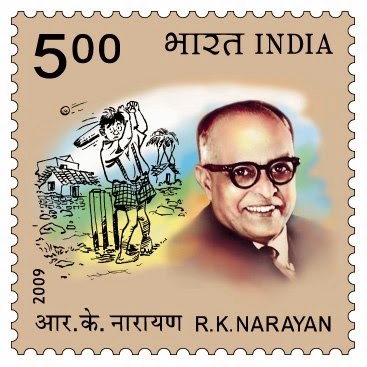
Featured Author: R. K. Narayan
Today's featured author is R. K. NARAYAN, one of India's best-known English-language authors. His short prose versions of the Ramayana and of the Mahabharata are both on the reading list for this class.
Narayan (Rasipuram Krishnaswami Iyer Narayanaswami) was born in 1906 and died in 2001 at the age of 94 — and thus he witnessed most of the tumultuous 20th century in India. You can read about his life and career in this detailed Wikipedia article. He is best known as a novelist and a writer of short stories, turning to these epic projects only in the 1970s, very late in his career. Narayan's version of the Ramayana is remarkable because it is based, not on Valmiki, but instead on Kamban's Tamil version of the Ramayana, which is in turn based on Valmiki but which also has a personality all its own.
This brief video gives you an overview of his life:



About Sanskrit... in 60 seconds
This is one of those 60-second videos from Epified: this time it gives you some quick facts about Sanskrit.
British Library's Ramayana Miniatures
William Dalrymple is one of the best writers on India today, and here is an essay he has written on Indian art:
All Indian life is here: The British Library's Ramayana miniatures - masterpieces of Hindu art, many painted by Muslims - are testimony to a time when religious relations on the subcontinent were less fraught.
In particular, he discusses the Mewar Ramayana: "The Mewar Ramayana - a seven-volume work that was produced by at least three different scriptoria and once included more than 400 paintings - is arguably the masterpiece of Rajasthani painting, and is certainly one of the supreme monuments of 17th-century Indian art.
In particular, he discusses the Mewar Ramayana: "The Mewar Ramayana - a seven-volume work that was produced by at least three different scriptoria and once included more than 400 paintings - is arguably the masterpiece of Rajasthani painting, and is certainly one of the supreme monuments of 17th-century Indian art.
And here is the illustration from the Mewar Ramayana that accompanies the essay: Awakening Kumbhakarna.

Friday, August 31, 2018
Video: Story of Rama through Indian Art
At Twitter, I saw an amazing illustration for the Ramayana (see the bottom of this post), which led me to this page: The Story of Rama: Indian Miniatures from the National Museum, New Delhi... and that brought me to this YouTube video. It is about 30 minutes long, which means it would work great for an extra credit "reading" option to do. After you finish reading the Ramayana, you can see how the presentation in this video resonates with the impression you had of the epic:

And here's the illustration that got me started: Ravana and his court full of rakshasas.
Monday, August 27, 2018
Free Book: Classical Telugu Poetry
This is another free public access book from the UC Press. It is still copyrighted, but you can read the entire book online for free!
Classical Telugu Poetry: An Anthology, translated by Velcheru Narayana Rao and David Shulman (2002).
The you will find some stories you know from the epics in here, like The Slaying of Kichaka.
The Telugu language belongs to the Dravidian language family of southern India. You can find out more about the Telugu language at Wikipedia, and there is also a long article about Telugu literature.
Wednesday, August 22, 2018
Spread of Religion
Since Hinduism, Buddhism, Christianity, and Islam have all been important in the history of India, I thought you might enjoy this video from Business Insider: This animated map shows how religion spread across the world.
Subscribe to:
Posts (Atom)